Further evidence for situational determinants of crime
The role of environmental and geographic features in explaining violence hotspots in Columbia, South America
Abstract
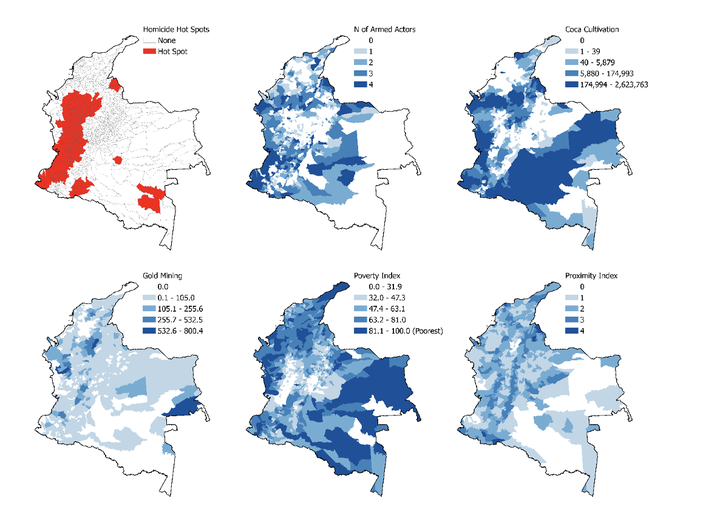
Government responses to violence associated with organized criminal groups have traditionally emphasized offender-based strategies aimed at incapacitating individuals and disrupting criminal organizations. Despite their long-standing use, these approaches show limited evidence of producing durable reductions in violence. Echoing the foundational insights of Mayhew et al. (1976) in Crime as Opportunity , researchers have increasingly recognized that organized crime activity is shaped by environmental conditions, opportunity structures, and the geographic distribution of resources. Yet empirical examinations of how these features contribute to the spatial concentration of violent crime linked to organized groups remain limited. This study applies GIS-based spatial analysis and multivariate regression modeling to investigate homicide concentrations in Colombia from 2010 to 2020, assessing the relative influence of organized offending groups alongside a range of situational and geographic characteristics. Results indicate that environmental features were significant predictors of homicide clustering, independent of the presence of organized crime groups. These findings further demonstrate the explanatory value of opportunity and environmental frameworks for understanding organized crime violence. They also highlight the importance of situational prevention strategies that seek to modify local opportunity structures rather than relying exclusively on offender-focused interventions.