Developing a new typology of risky facilities to improve situational crime prevention strategies
Abstract
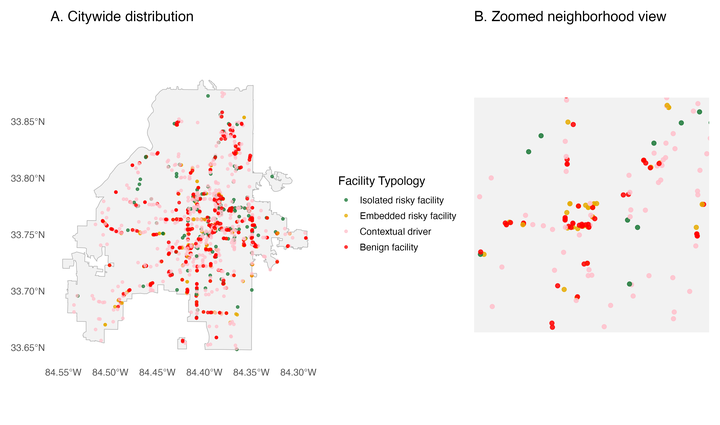
The risky facilities framework posits that a small subset of locations accounts for a disproportionate share of crime compared to similar places. Although influential in crime science, the measurement of risky facilities does not account for the spatial context surrounding these facilities. We analyze 227,447 crime incidents in Atlanta from 2021 to 2024 to classify variation among facilities by integrating relative crime volume with contextual measures of local crime patterns. We examine three common facility types: gas stations, convenience stores, and restaurants. These places are analyzed within a hierarchical spatial framework that nests facilities within their surrounding street segments. By combining within-facility crime rankings with segment-level crime shares, we develop a dual-axis typology that distinguishes between intrinsic facility risk and contextual representation of crime patterns. Results reveal substantial heterogeneity in crime patterns across facilities. Some low-volume facilities still account for all recorded crime on otherwise low-activity street segments. Only a small minority of high-crime facilities function as isolated risky facilities, accounting for most of the crime in their surrounding segments. Most high-risk facilities are embedded within broader criminogenic environments where crime is more evenly distributed across multiple locations. Risky facilities should not be uniform targets for crime control interventions. The most efficient prevention strategies should consider diagnosing the degree to which crime is driven by facility-specific management issues or broader ecological conditions. Isolated risky facilities are best suited for situational crime prevention, emphasizing place management and on-site guardianship. Conversely, embedded risky facilities require intervention techniques targeting shared environmental conditions. By incorporating contextual diagnostics into the risky facilities framework, this study provides a more precise problem analysis foundation to help efficiently allocate resources for place-based crime prevention strategies.