Shadow signals at sea
Spatial patterns of dark vessels flying flags-of-convenience and maritime crime risk in West Africa
Abstract
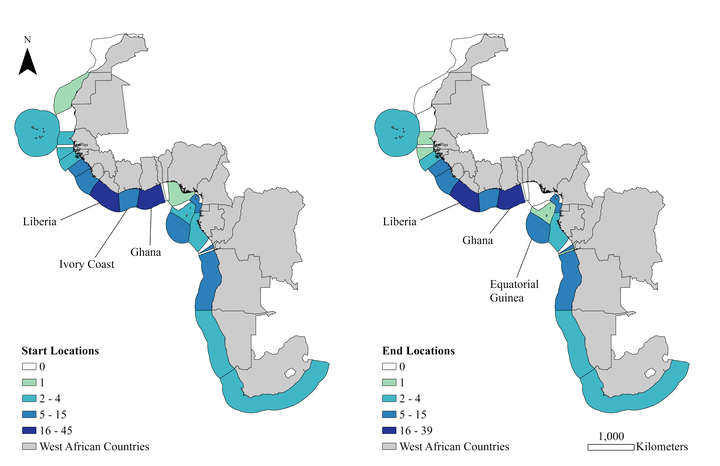
Commercial fishing vessels that disable their automatic identification system (AIS) transponders, commonly referred to as dark vessels, pose a growing challenge for maritime governance, environmental monitoring, and preventing illegal, unreported, and unregulated (IUU) fishing. AIS disabling is often a calculated behavior to evade detection while fishing illegally or engaging in unregulated exchanges with transshipment vessels. Such activity is especially prevalent in regions with limited enforcement capacity and is thought to occur along or inside exclusive economic zones, or territorial waters of nations. This study examines the spatial distribution and co-location of two vessel classes in West African waters: 1) dark vessels operating under flags of convenience, a recognized risk factor for IUU fishing, and (2) non-convenience-flagged dark vessels. Using open-access AIS data and vessel registry information from Global Fishing Watch, kernel density and Getis-Ord Gi* analyses show that convenience-flagged dark journeys differ from non-convenience-flagged ones, though Lee’s L tests indicate spatial similarities, too. Convenience-flagged dark journeys were more likely to start or end outside or near maritime boundary edges, and this pattern was uneven across West African national maritime boundaries. Finally, repeated AIS disabling was highly concentrated: 11 convenience-flagged vessels accounted for 73 percent of dark journeys, and convenience-flagged vessels averaged nearly six dark journeys per vessel compared to just over one for non-convenience-flagged vessels. Interpreted through a crime-science lens, these findings highlight how opportunity structures and enforcement gaps shape illicit maritime activity. The study contributes a scalable, spatial approach to identifying and monitoring IUU fishing risk, offering practical insights for adaptive, time-aware maritime enforcement strategies.